How to Choose LED Strip Lights for Cabinet, Shelf and Display Applications
A specification-focused explainer for distributors, contractors and designers choosing LED strip for cabinet, shelf and display lighting.
For cabinet and shelf display lighting, LED strip lights should be chosen around the display task: what is being shown, viewing distance, surface finish and how much brightness the merchandise can tolerate. A good starting point is a 24 V strip with a high colour-rendering option, controlled density and a diffused profile that hides individual diodes. The strip alone is not the result; the aluminium profile, diffuser, driver and dimming method determine whether the shelf looks clean and evenly lit or produces hotspots, glare and shadow. This guide explains the configuration choices, installation constraints and practical limits that distributors, contractors and designers should resolve before specifying or purchasing.
Key Takeaways
- Define the display task first: merchandise colour, viewing angle, brightness tolerance and desired contrast.
- Use diffusion and spacing to avoid diode images on glossy shelves and close-up displays.
- Match strip density, output and CRI to the shelf depth rather than choosing the highest output.
- Allow for driver location, voltage drop, dimming compatibility and future access before fixing profiles.
- Test a mock-up shelf under real lighting; paper calculations rarely show hotspots or glare.
Configuration decisions for cabinet and shelf LED strip lighting
| Design decision | Specify when | Avoid when |
|---|---|---|
| High-density or COB-style strip | Short shelf depths, close viewing and tight diffusers | Deep shelves needing a broad wash at low cost |
| Standard strip in aluminium profile | General cabinet and shelf lighting with a hidden source | Very shallow reveals or an exposed-diode look is acceptable |
| Higher CRI option | Retail displays, artwork, food and textiles where colour matters | Utility shelving where colour accuracy is not critical |
| Dimmable driver and compatible controller | Display areas needing scene changes or low overnight light | Simple switched cabinet lighting with no adjustment need |
Start with the display task, not the strip
Display lighting is not general illumination; it shapes how the eye reads the shelf.
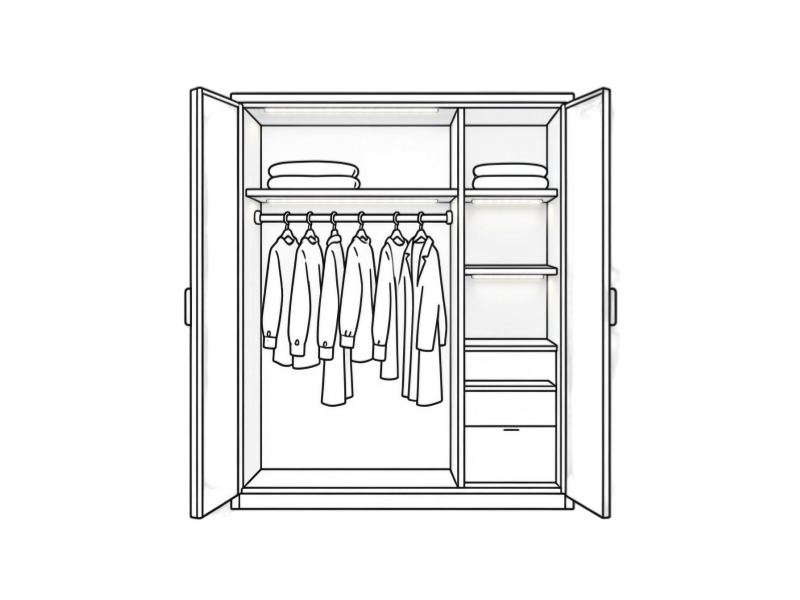
Define the object first. A glassware cabinet needs a soft, even wash with low glare so reflections do not hide the product. A textile or packaged-goods display may need enough vertical illumination to show colour and detail without washing out labels. A timber shelf may benefit from a gentle grazing effect that reveals grain, while a tool or component display may need stronger contrast. Also define the viewer position: a customer standing close sees diode images and glare that disappear from across a room. Cabinet lighting is usually seen at short range, so brightness tolerance is lower than for ceiling lighting. Before choosing a strip, agree on the lit object, shelf depth, viewing angle, surface finish and whether the source will be visible. These answers determine strip density, diffuser type, mounting angle and dimming more reliably than a catalogue lumen figure.
Choose the LED strip configuration for the shelf
The strip configuration should follow the shelf geometry, not the other way around.
For most cabinet and shelf work, a linear LED strip mounted in an aluminium profile with an opal or frosted diffuser is the practical base specification. The profile gives mechanical protection, a heat path and a clean line of light; the diffuser hides the diodes. Where shelves are shallow or viewed very close, a high-density strip or COB-style strip can reduce the chance of dotting, provided the diffuser and recess depth are adequate. For deeper shelves, a single strip at the front may leave the rear dark, so consider two runs, an angled mounting or a deeper profile. Colour rendering matters in retail and display: a higher CRI option helps textiles, food, artwork and branded packaging read accurately, but it should be balanced against output and cost. Colour temperature should suit the merchandise and surrounding joinery, and the control method should allow dimming because shelf displays are often over-lit at full output. Ask for a sample and test it in the actual shelf before committing.
Mounting, diffusion and heat in cabinet lighting
Mounting detail decides whether the result looks like a designed line of light or an exposed tape.
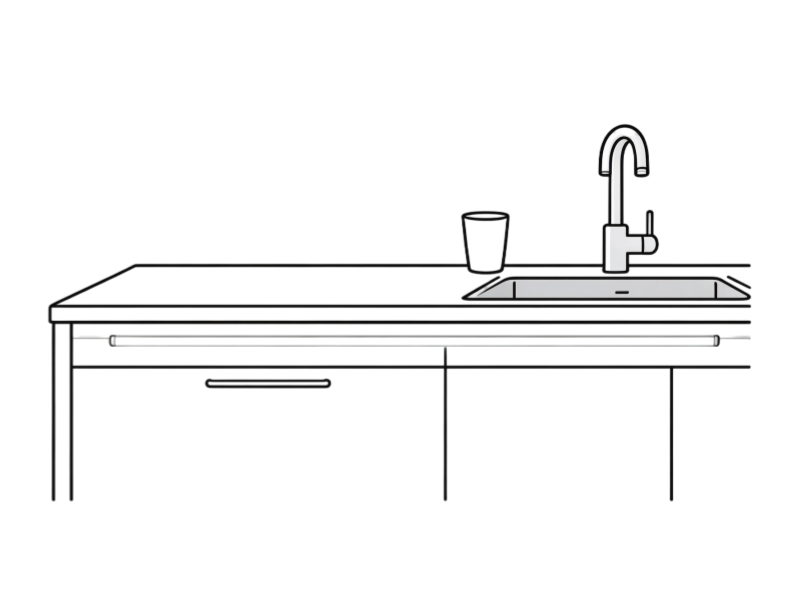
Recess the profile where possible so the diffuser sits flush with the shelf or cabinet surface. Surface-mounted profiles can work, but they are more visible and easier to damage. Angle the strip away from the viewer and toward the display surface to reduce glare; a front-mounted strip aimed straight out often shows reflections on glossy shelves, glass and screens. Keep the source behind a lip or baffle if the shelf is viewed from below. Diffusion is a trade-off: stronger diffusion softens hotspots but reduces delivered light, so the strip output and profile depth must be considered together. Heat is another constraint in closed cabinets. LEDs produce less heat than traditional sources, but drivers and strips still need a thermal path and some ventilation. Do not seal a high-output strip into an insulated timber cavity without checking the manufacturer's ambient and installation limits. Leave access for cleaning and future replacement.
Power, control and wiring constraints
Power and control choices are often fixed too late, after joinery and shelf positions are set.
Decide where the driver will live before the cabinet is built. Drivers need accessible, ventilated positions, and remote drivers may require longer low-voltage cable runs. On long shelf runs, voltage drop can cause brightness variation from one end to the other; the practical response is to use the correct cable size, limit run length or feed the strip from both ends where the product permits. Dimming is valuable in display lighting because full output is rarely needed all day. Confirm that the driver, controller and strip are compatible, especially where wireless remotes, scene control or architectural dimming are expected. For each project market, confirm that drivers, wiring and installation meet local electrical requirements and that the dimming method is supported by the product datasheet. Avoid specifying a controller family before checking its low-load behaviour and standby performance.
Common mistakes and practical limits
Most failures are predictable and appear in the first mock-up if the right questions are asked.
Common mistakes include choosing the brightest strip for a small shelf, leaving diodes visible, using adhesive tape as the only fixing method, and specifying a colour temperature before checking it against the merchandise. Another frequent error is treating the diffuser as optional; on glossy shelves and close viewing, exposed diodes look unresolved and can create harsh reflections. Overlong runs without adequate feed points cause dimming at one end, while inaccessible drivers turn a minor fault into a joinery problem. Practical limits matter too. A strip cannot correct a shelf that is too deep for a single light line, and a very shallow reveal may not accept a profile with enough diffusion. High output in a sealed cabinet can shorten product life. The reliable process is a physical mock-up under the real ambient light, followed by a specification that records strip type, diffuser, driver, control and mounting detail.
Cabinet and shelf LED strip lighting is a system decision, not a strip purchase. The best result comes from matching the display task to strip density, diffusion, colour quality and mounting, then checking driver access, dimming and heat before the joinery is closed. For distributors and contractors, a documented mock-up and a clear specification reduce returns and site fixes. Treat catalogue output figures as a starting point only; the shelf, diffuser and viewing distance will decide the final visual result.
For a complete installation context, review the cabinet and furniture lighting solution. Product-family choices start with the LED strip lights and a profile matched to the actual shelf depth.